Article notes
Notes, guides, and personal discoveries from things I build, enjoy, and learn.
Continuing from our previous post on optimizing development workflows, today we’ll explore the power of Visual Development Experience (VDE) with Storybook in Action, alongside Next.js. While our last discussion emphasized the importance of pre-commit systems in ensuring code quality and stability, this post dives into enhancing UI development through Storybook’s isolated component environment. Let’s unlock the potential of these tools to streamline development, foster collaboration, and maintain UI consistency across projects.
Read the Previous Post: Implementing Husky for Next.js
Getting Started with Storybook
To integrate Storybook into your Next.js project, simply execute the following command:
npx sb initThis command initiates the installation of necessary dependencies, configuration setups, and file creations.
Once installed, start Storybook to visualize and interact with your components in an isolated environment:
npm run storybookyarn run storybookpnpm run storybookbun run storybookI recommend removing demo components and configuring your existing components with Storybook. In our case, as we are utilizing aliases for imports, they might pose compatibility issues. To address this, add the following configuration to Storybook:
.storybook/main.ts
import type { StorybookConfig } from "@storybook/nextjs";
import path from 'path'

const config: StorybookConfig = {
  stories: ["../src/**/*.mdx", "../src/**/*.stories.@(js|jsx|mjs|ts|tsx)"],
  addons: [
    "@storybook/addon-onboarding",
    "@storybook/addon-links",
    "@storybook/addon-essentials",
    "@chromatic-com/storybook",
    "@storybook/addon-interactions",
  ],
  framework: {
    name: "@storybook/nextjs",
    options: {},
  },
  docs: {
    autodocs: "tag",
  },
  staticDirs: ["../public"],
  webpackFinal: async (config) => {
    if (!config.resolve) return config;

    config.resolve.alias = {
      ...config.resolve.alias,
      '@/': path.resolve(__dirname, '../src/'),
      '@/atoms': path.resolve(__dirname, '../src/components/atoms'),
      '@/molecules': path.resolve(__dirname, '../src/components/molecules'),
      '@/organisms': path.resolve(__dirname, '../src/components/organisms')
    };

    return config;
  }
};

export default config;
Note: New typescript way to implement aliases is better, in future post we can move our alias config to that
With this configuration, we resolve the issue seamlessly.
Tailwind Integration
Enabling Tailwind support is straightforward. Simply include the following line in the Storybook preview:
.storybook/preview.ts
import "../src/app/globals.css";Here’s an example:
.storybook/preview.ts
import type { Preview } from "@storybook/react";

import "../src/app/globals.css";

const preview: Preview = {
  parameters: {
    controls: {
      matchers: {
        color: /(background|color)$/i,
        date: /Date$/i,
      },
    },
  },
};
export default preview;
Now, with Storybook installed in our project, let’s proceed with some adjustments.
Optional, but recommended
In many projects, root configurations can become overwhelming. Thus, I advocate for managing configurations within a dedicated folder. Although optional, I highly recommend moving the .storybook folder into config/.storybook.
To achieve this, make the following modifications:
Move main and preview from the root project to:
├── /config
| ├── /.storybook
| | ├── /main.ts
| | ├── /preview.ts
Adjust the Storybook scripts in package.json:
package.json
{
  "scripts": {
    "storybook": "storybook dev -p 6006 -c config/.storybook",
    "build-storybook": "storybook build -c config/.storybook"
  }
}
And update the Storybook main config:
config/.storybook/main.ts
import type { StorybookConfig } from "@storybook/nextjs";
import path from 'path'

const rootDir = path.resolve(__dirname, '../..');

const config: StorybookConfig = {
  stories: [`${rootDir}/**/*.mdx`, `${rootDir}/**/*.stories.@(js|jsx|mjs|ts|tsx)`],
  addons: [
    "@storybook/addon-onboarding",
    "@storybook/addon-links",
    "@storybook/addon-essentials",
    "@chromatic-com/storybook",
    "@storybook/addon-interactions",
  ],
  framework: {
    name: "@storybook/nextjs",
    options: {},
  },
  docs: {
    autodocs: "tag",
  },
  staticDirs: [`${rootDir}/public`],
  webpackFinal: async (config) => {
    if (!config.resolve) return config;

    config.resolve.alias = {
      ...config.resolve.alias,
      '@/': `${rootDir}/src/`,
      '@/atoms': `${rootDir}/src/components/atoms`,
      '@/molecules': `${rootDir}/src/components/molecules`,
      '@/organisms': `${rootDir}/src/components/organisms`
    };

    return config;
  }
};

export default config;
config/.storybook/preview.ts
import type { Preview, ReactRenderer } from "@storybook/react";
import { withThemeByClassName } from '@storybook/addon-themes';
import '@storybook/addon-console';

import "../../src/app/globals.css";

// Preview configurations...

export default preview;
Now, creating component stories is straightforward. Let’s use our button component as an example:
src/components/atoms/button/button.stories.ts
import Button, { type ButtonProps, ButtonSizes, ButtonVariations } from './button'

import type { Meta, StoryObj } from '@storybook/react'
import { fn } from '@storybook/test'

const meta = {
  title: 'Design System/Atoms/Button',
  component: Button,
  parameters: {
    layout: 'centered'
  },
  tags: ['autodocs'],
  args: { onClick: fn() },
  argTypes: {
    variation: {
      control: { type: 'select' },
      description: 'The variation of button',
      options: Object.values(ButtonVariations),
      table: {
        defaultValue: { summary: ButtonVariations.Primary },
        type: { summary: 'ButtonVariations' }
      }
    },    size: {
      control: { type: 'select' },
      description: 'The size of button',
      options: Object.values(ButtonSizes),
      table: {
        defaultValue: { summary: ButtonSizes.Medium },
        type: { summary: 'ButtonSizes' }
      }
    }
  }
} satisfies Meta<typeof Button>

export default meta

type Story = StoryObj<ButtonProps>

export const Primary: Story = {
  args: {
    label: 'Primary Button',
    variation: ButtonVariations.Primary,
    size: ButtonSizes.Medium
  }
}

export const Secondary: Story = {
  args: {
    label: 'Secondary Button',
    variation: ButtonVariations.Secondary
  }
}

export const Success: Story = {
  args: {
    label: 'Success Button',
    variation: ButtonVariations.Success
  }
}

export const Danger: Story = {
  args: {
    label: 'Danger Button',
    variation: ButtonVariations.Danger
  }
}

export const Small: Story = {
  args: {
    label: 'Primary Button',
    variation: ButtonVariations.Primary,
    size: ButtonSizes.Small
  }
}

export const Medium: Story = {
  args: {
    label: 'Primary Button',
    variation: ButtonVariations.Primary,
    size: ButtonSizes.Medium
  }
}

export const Large: Story = {
  args: {
    label: 'Primary Button',
    variation: ButtonVariations.Primary,
    size: ButtonSizes.Large
  }
}
In the repository, you’ll find two additional examples, covering both Vitest and stories.
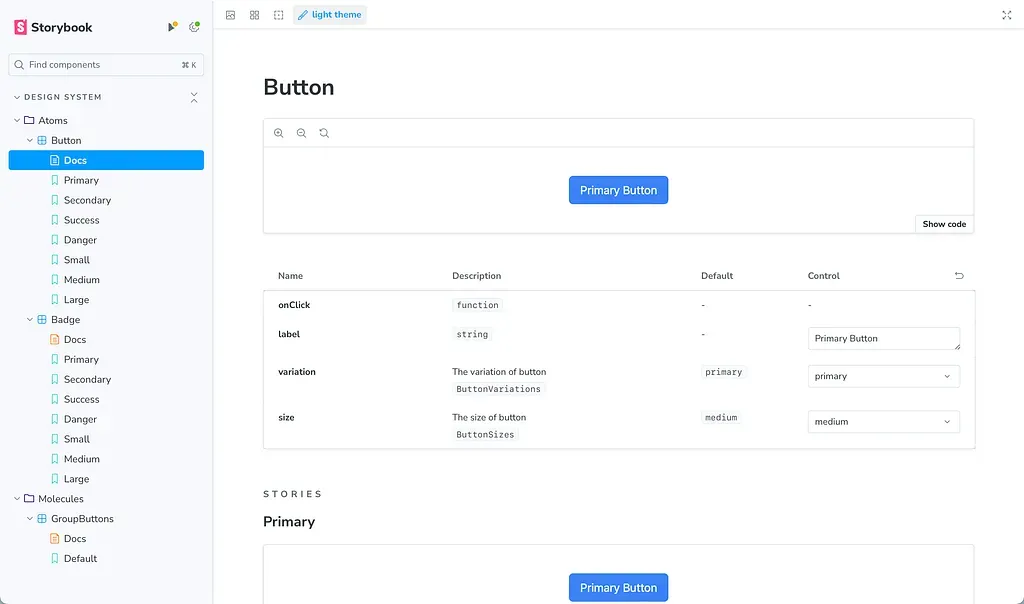
The end result will resemble this:
Enhancing Your Storybook with Integrations
- Themes: https://storybook.js.org/addons/@storybook/addon-themes Prepare for future enhancements by implementing light and dark themes.
- Storysource: https://storybook.js.org/addons/@storybook/addon-storysource Gain insights into the source code of your stories for improved development workflows.
- Console: https://storybook.js.org/addons/@storybook/addon-console Debug and troubleshoot your components effectively with integrated console logs.
- HTML Preview: https://storybook.js.org/addons/@whitespace/storybook-addon-html Visualize and inspect HTML code snippets directly within Storybook for rapid prototyping.
- Pseudo States: https://storybook.js.org/addons/storybook-addon-pseudo-states Simulate pseudo states such as hover, focus, and active states for thorough component testing.
To install these integrations, choose your package manager:
npm install --save-dev @storybook/addon-themes @storybook/addon-storysource @storybook/addon-console @storybook/addon-actions @whitespace/storybook-addon-html storybook-addon-pseudo-statesyarn add --dev @storybook/addon-themes @storybook/addon-storysource @storybook/addon-console @storybook/addon-actions @whitespace/storybook-addon-html storybook-addon-pseudo-statespnpm add --save-dev @storybook/addon-themes @storybook/addon-storysource @storybook/addon-console @storybook/addon-actions @whitespace/storybook-addon-html storybook-addon-pseudo-statesbun add --dev @storybook/addon-themes @storybook/addon-storysource @storybook/addon-console @storybook/addon-actions @whitespace/storybook-addon-html storybook-addon-pseudo-statesNote
While these are recommended integrations, feel free to explore and install additional ones based on your project requirements. You can find more integrations on the Storybook Integrations page.
Once installed, update your Storybook configuration files as follows:
config/.storybook/main.ts
import type { StorybookConfig } from "@storybook/nextjs";
import path from 'path'

import '@storybook/addon-console';

const rootDir = path.resolve(__dirname, '../..');

const config: StorybookConfig = {
  stories: [`${rootDir}/**/*.mdx`, `${rootDir}/**/*.stories.@(js|jsx|mjs|ts|tsx)`],
  addons: [
    "@storybook/addon-onboarding",
    "@storybook/addon-links",
    "@storybook/addon-essentials",
    "@chromatic-com/storybook",
    "@storybook/addon-interactions",
    "@storybook/addon-themes",
    "@storybook/addon-storysource",
    "@whitespace/storybook-addon-html",
    "storybook-addon-pseudo-states"
  ],
  framework: {
    name: "@storybook/nextjs",
    options: {},
  },
  docs: {
    autodocs: "tag",
  },
  staticDirs: [`${rootDir}/public`],
  webpackFinal: async (config) => {
    if (!config.resolve) return config;
    config.resolve.alias = {
      ...config.resolve.alias,
      '@/': `${rootDir}/src/`,
      '@/atoms': `${rootDir}/src/components/atoms`,
      '@/molecules': `${rootDir}/src/components/molecules`,
      '@/organisms': `${rootDir}/src/components/organisms`
    };
    return config;
  }
};
export default config;
config/.storybook/preview.ts
import type { Preview, ReactRenderer } from "@storybook/react";
import { withThemeByClassName } from '@storybook/addon-themes';
import '@storybook/addon-console';

import "../../src/app/globals.css";

const preview: Preview = {
  parameters: {
    controls: {
      matchers: {
        color: /(background|color)$/i,
        date: /Date$/i,
      },
    },
  },
  decorators: [
    withThemeByClassName<ReactRenderer>({
      themes: {
        light: 'light',
        dark: 'dark',
      },
      defaultTheme: 'light',
    }),
  ]
};

export default preview;
Conclusions
By integrating these powerful Storybook with this addons, you can elevate your development workflow, streamline component testing, and enhance collaboration within your team. Experiment with different integrations to tailor Storybook to your project’s unique needs, fostering a more efficient and productive development environment.
Before integrating Storybook, consider ongoing maintenance. It’s crucial for updated documentation and avoiding issues. Regular upkeep includes component updates, testing, and dependency compatibility checks. Evaluate benefits against maintenance effort based on project stage and resources.
Building a Production Next.js App
A practical sequence for turning a fresh Next.js codebase into a product teams can lint, test, document, deploy, and secure with confidence.
- 1Part 1Atomic Module Component Structure for React
- 2Part 2Building the Best Next.js TypeScript Standard Vitest ESLint Configuration
- 3Part 3Development Workflow with Husky for Next.js, ESLint, and Vitest Integration
- 4Part 4Storybook in Action with Next.js, Tailwind and TypeScript
- 5Part 5Testing React Components with Vitest and React Testing Library
- 6Part 6Continuous Integration and Deployment for Next.js Projects
- 7Part 7Authentication and Authorization in Next.js Applications with Supabase
- 8Part 8Playwright Accessibility Checks That Teams Keep Running
Comments
Powered by GitHub Discussions — sign in with GitHub to join the conversation, orreply on GitHub.